Meditation on the Mirror
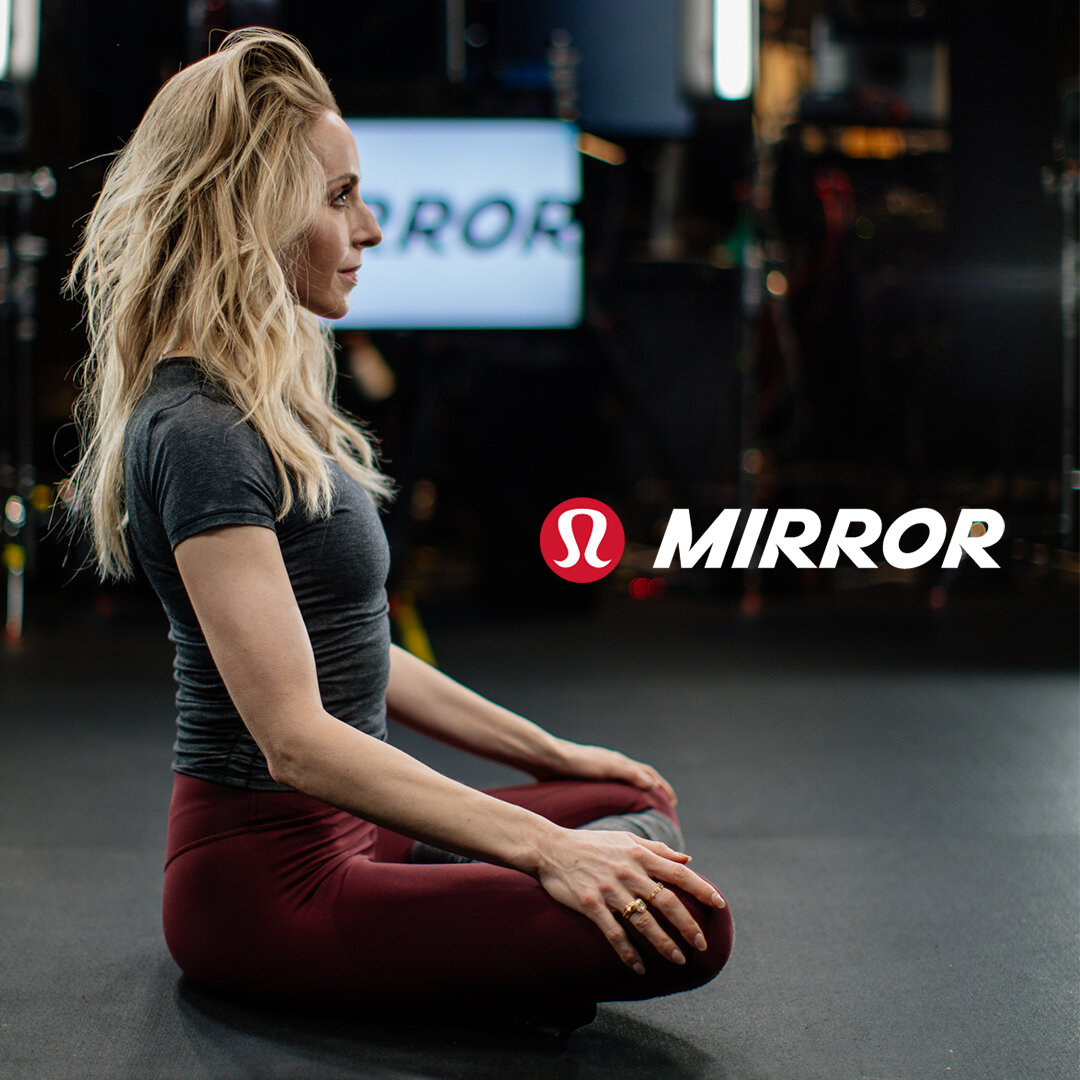
MIRROR partnered with Lululemon to bring Meditation content into the mirror guided by Lululemon ambassadors.
Responsibilities
Designed the user experience and interface for iOS/Android and MIRROR platform.
Lead brainstorm sessions to better understand our challenges and solutions.
Conducted competitor research and pulled visuals for design inspiration.
Presented various rounds of prototypes to stakeholders.
Outsourced and managed animation freelancers.
Worked with Product Manager, QA, iOS and Android Engineering for product shipment.
The goal
Design a premium experience that brings Lululemon ambassadors into the Mirror with the goal of introducing more content into the MIRROR platform.
Design challenges
What does meditation content look like within the Mirror app?
What does open-eye meditation look like on the Mirror?
How do we help decrease user heart rate?
How do we graphically display heart rate data, instructional cues, etc?
How do we co-brand this experience with Lululemon?
What are other people doing?
Meditation is a billion dollar industry and startups like Calm and Headspace dominate the category offering guided meditation sessions for anxiety, stress, sleeping, and more through their apps.

Headspace
Headspace uses quirky cartoons to better educate on things like anxiety and stress while guiding users through closed-eye meditation sessions via their mobile app. They also offer sessions for sleep, work/productivity and fitness.
Calm
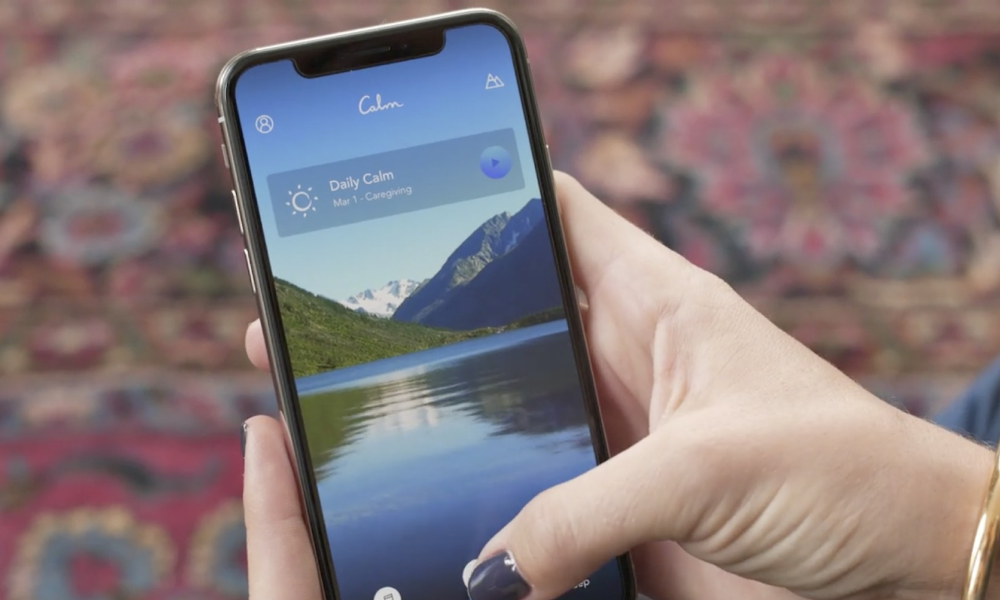
Calm lets listeners choose from several different meditation teachers and peaceful nature scenes. About half of Calm’s users use it primarily as a sleep app rather than a meditation app.
Lightbulb moment
We couldn’t find one meditation service that guides users thru an open-eye meditation. Being that MIRROR is a “see yourself” product, we knew we would be the first to create something magical in an untapped space that was uniquely ours.
What will they see?
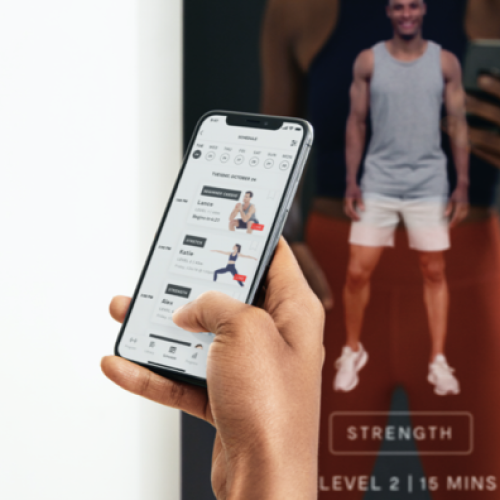
In the app: Meditation content looks and feels like just like the rest of the MIRROR fitness content. Since meditation is new, we merchandise the content more prominently on the Home tab, providing users with education and a shortcut to the Meditation catalog.
On the Mirror: Our main design focus was to graphically show the heart rate data we were already capturing and introduce calming visuals that inform users when to breath, focus and if their posture is correct.
In the App
Welcoming meditation into our catalog
With meditation being a calming practice, we quickly realized we couldn’t treat it the same as our fitness content. This warranted a global opportunity to lift words like “workout” and replace them with words like “session”, so we could universally grow into new content categories. We also make tweaks on how we spoke to users before and after they have meditated. e.g. Asking users “How Do You Feel?” after a session, rather than “Rate The Difficulty”.
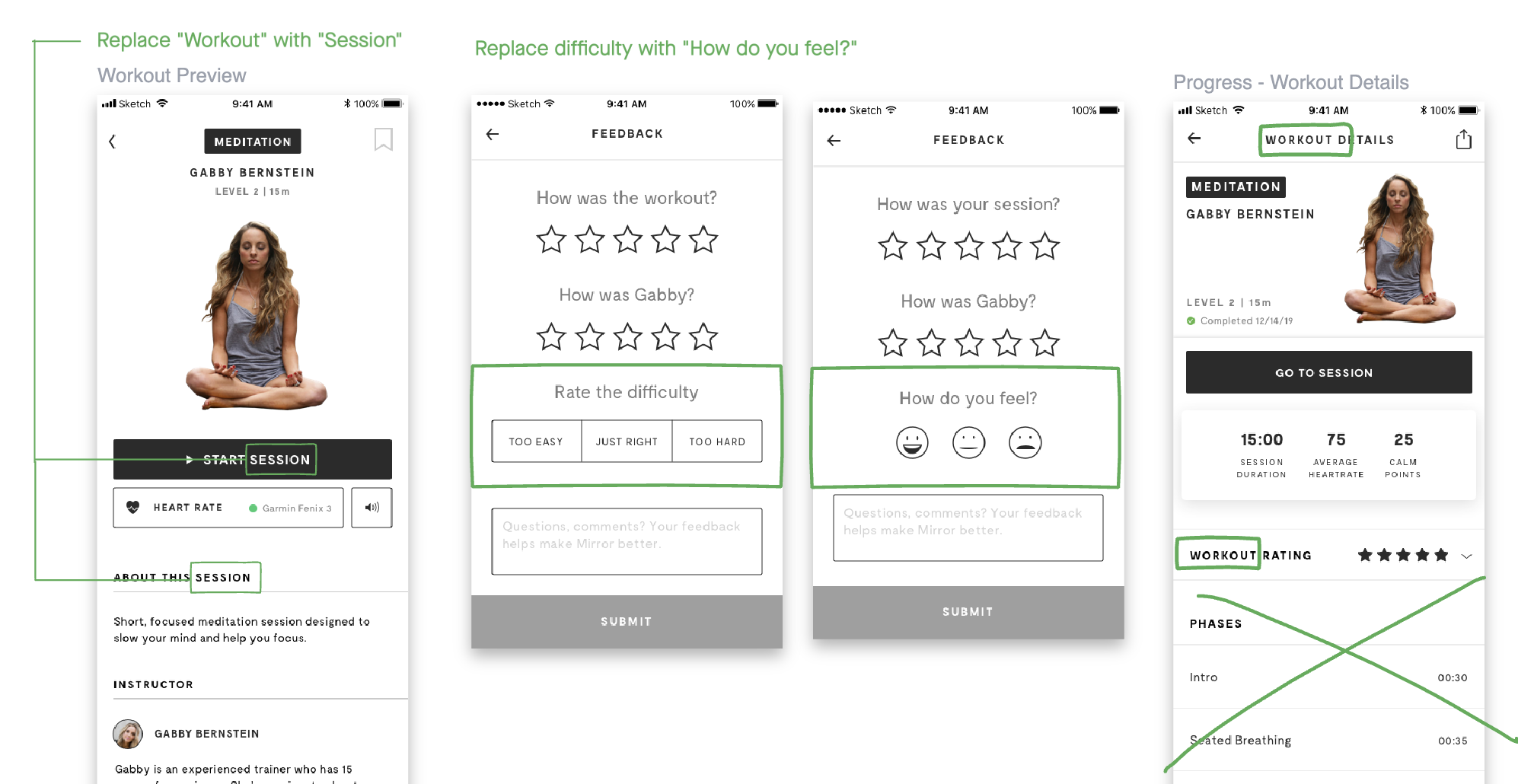
Finding a Meditation class
The MIRROR app controls what content is displayed on the actual Mirror. To begin a session, users must first choose a class within the app. With Meditation, we made it one-step easier to find a class by making it the first thing users see on the Home tab.

On the Mirror
What does open-eye meditation look like?
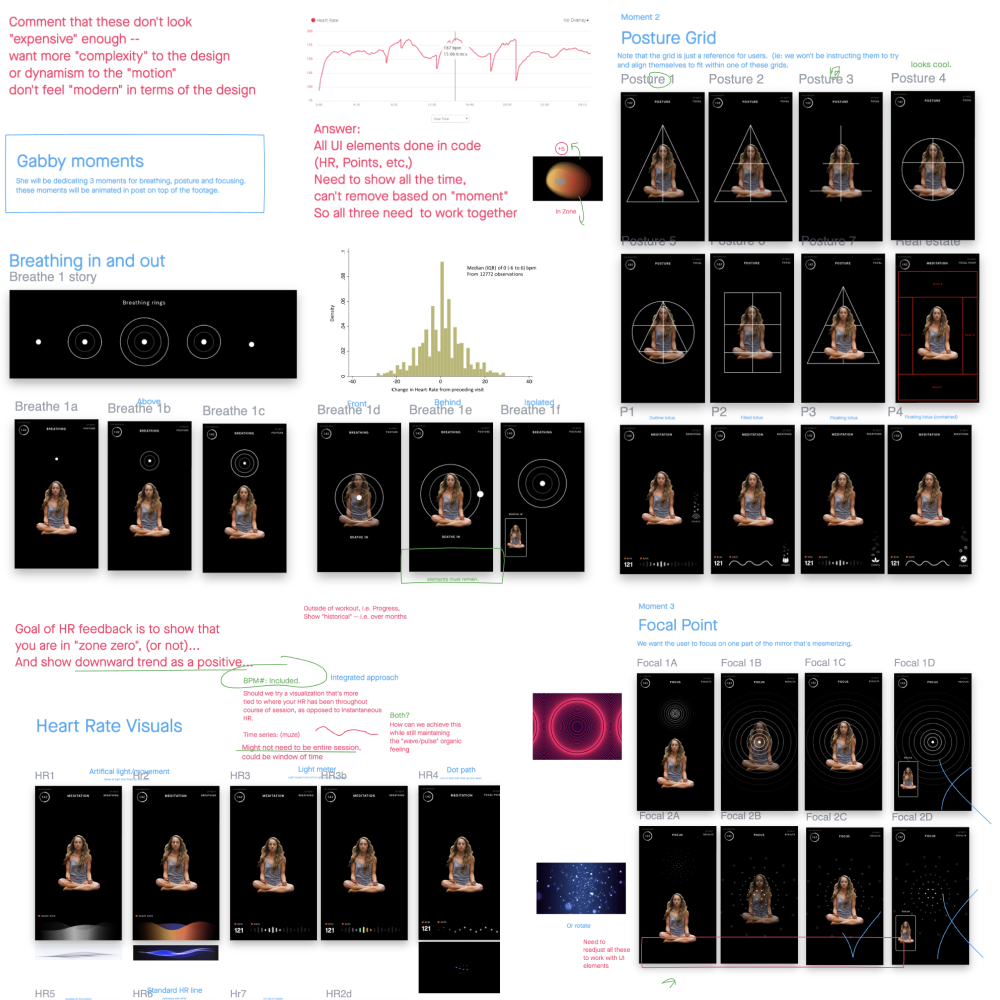
To stay within the MIRROR brand aesthetic, we needed calming visuals that felt modern, minimal, and premium.

Heart rate
How can we graphically show the heart rate data we are capturing in a calming motion?

Breathing cues
How do we visually remind users when to inhale and exhale?
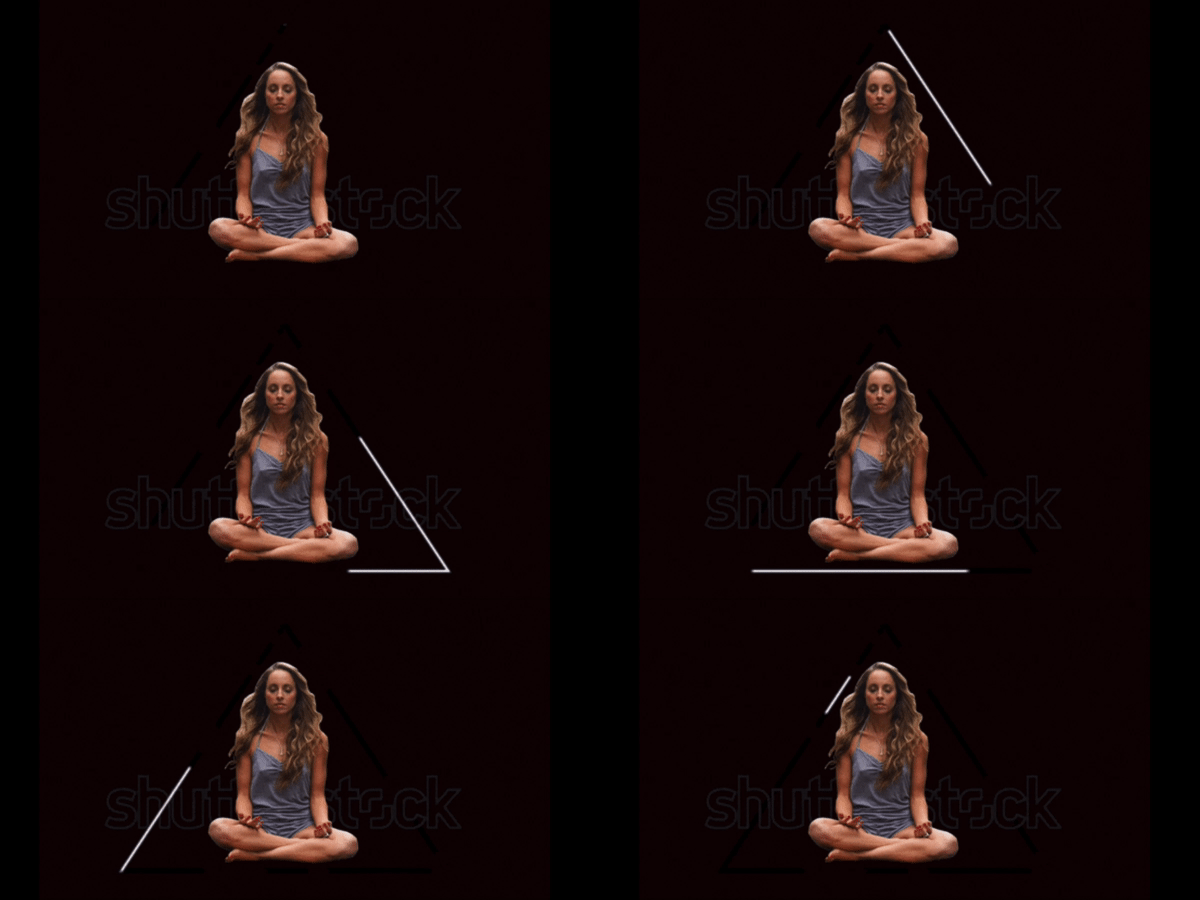
Posture guide
How do we educate users on proper form while on the floor?

Focal point
How do we calm our users down so they can focus on themselves?
Explorations
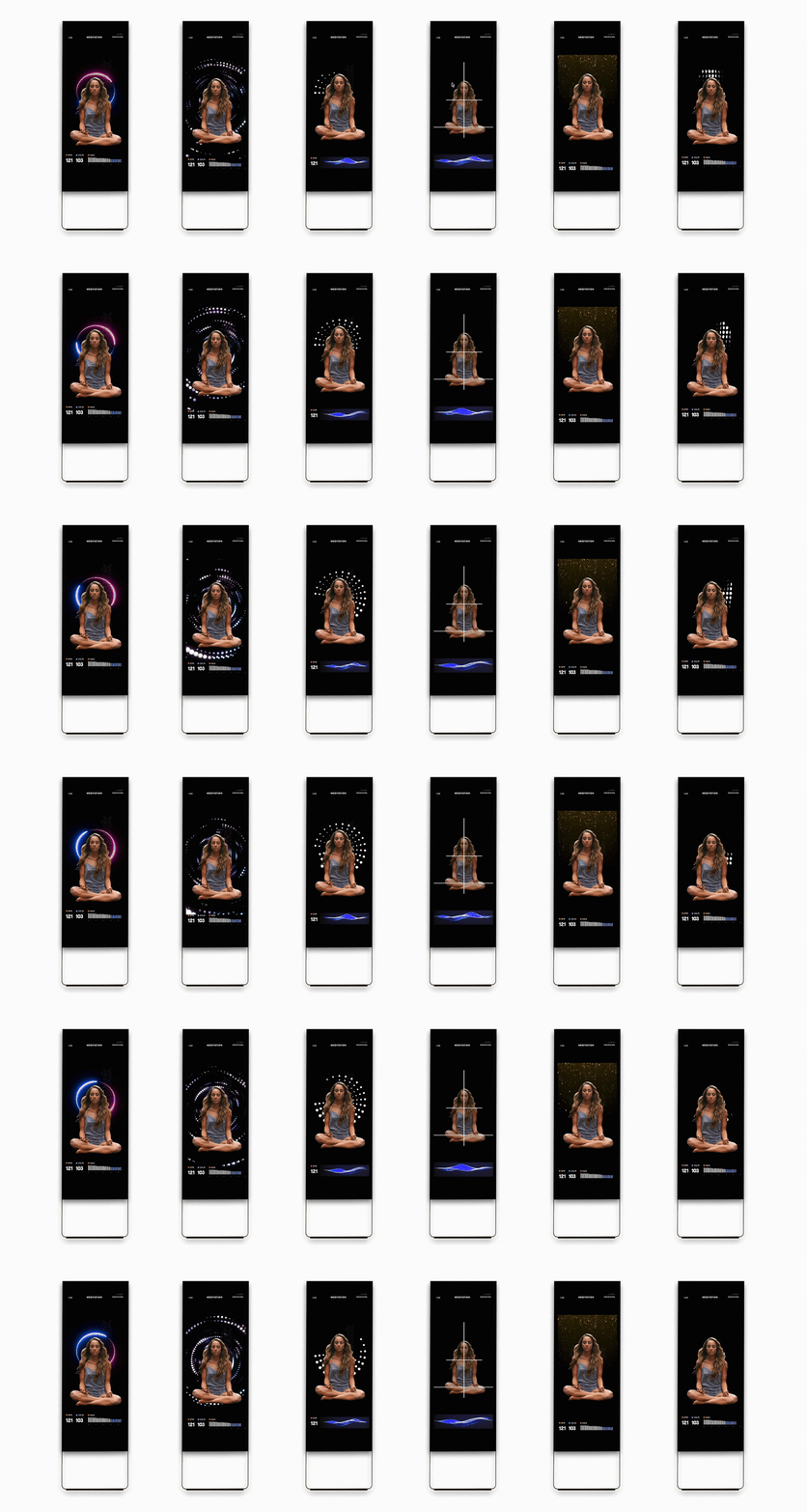
What we came up with
Heart rate waves
How it works:
When users connect their heart rate monitors to the Mirror, we capture and categorize their heart rate data (BPM) into two ranges: In-Zone and Out-Zone.
During the onboarding experience, each user creates a profile stating their fitness goals and each session has an In-Zone and Out-Zone range based on their unique profile.
Example:
Skyler is a 30 year old man, weighing 200lbs, and his goal is to lose weight,
His “In-Zone” range would be between 120-130 BPM. Meaning, if he keeps his heart rate between 120-130 BPM throughout his sessions, he will be on track to achieve his weight-loss goal.
If Skyler takes a Meditation session, we would decrease his “In-Zone range” to 75-85 BPM. In this case, the goal is to calm him down.
In-Zone and Out-Zone waves are differentiated by speed/frequency and amplitude. , The waves will alternate in-and-out depending upon which zone the user is in.
Posture guide
This visual helps users achieve best posture when meditating. The triangle is a common element in mediation practices as it mimics the body shape when in proper form. The vertical guide symbolizes the backbone and reminds users to keep their backs straight throughout the session.
Breathing cues
A visual expression of inhalation and exhalation. The expanding/contracting behavior is intended to help users visualize their breathing and to stay on tempo.
Focal point
A mesmerizing visual that cues the user to focus on the center of the mirror while the instructor guides them through self-encouragement.

Everyone is Meditating!
From our October 2019 launch, over 25,000 members have meditated with a return average of 44%.

The ultimate result!
Lululemon to buy MIRROR. The $500 million purchase is the company’s first acquisition and follows its $1 million investment in MIRROR in 2019.